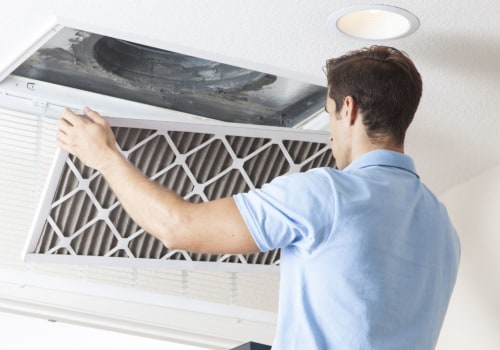
Choosing the wrong MERV rating for your air filter isn't just a minor inconvenience — it can quietly undermine your indoor air quality, strain your HVAC system, and cost you money every month. With a less common size like 12x26.5x4, the stakes are even higher: you've already tracked down the right dimensions, so getting the filtration level right matters just as much as getting the fit right.
The good news? Picking the right MERV rating for 12x26.5x4 air filters comes down to a few practical questions about your home, your household, and your system. Whether you're managing allergies, protecting pets, or just trying to keep your air clean year-round, this guide cuts through the noise so you can make a confident, informed decision.
TL;DR Quick Answers
What MERV Rating Should You Choose for 12x26.5x4 Air Filters?
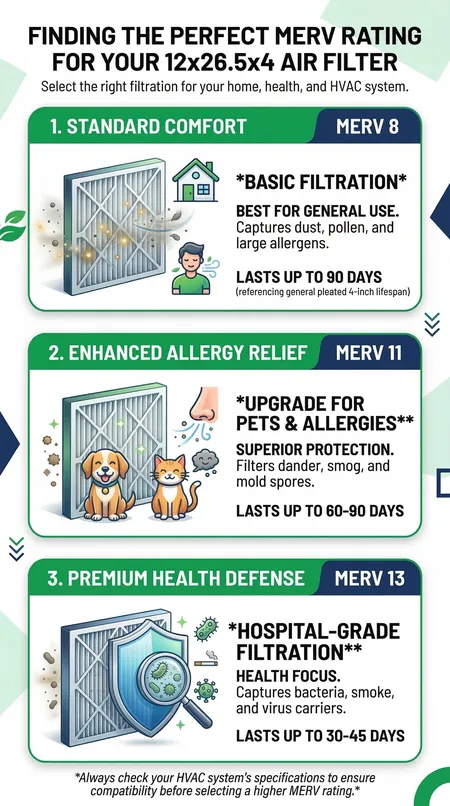
MERV 8: Best for standard homes with no allergy concerns. Captures dust, pollen, and mold spores. Good baseline filtration.
MERV 11: Best for homes with pets, mild allergy sufferers, or anyone wanting better particle capture without major airflow restrictions.
MERV 13: Best for allergy or asthma households, high-traffic homes, or anyone prioritizing health-first air quality. Captures fine particles, including smoke and bacteria carriers.
Always verify your HVAC system's fan capacity before upgrading. An air filter your system can't support does more harm than good.
Top Takeaways
MERV 8 is a solid baseline for standard homes with no specific air quality concerns.
MERV 11 is the sweet spot for most households — especially with pets or light allergy sensitivity.
MERV 13 delivers the strongest protection for allergy, asthma, or health-priority households.
Always confirm your HVAC system's compatibility before moving to a higher MERV rating.
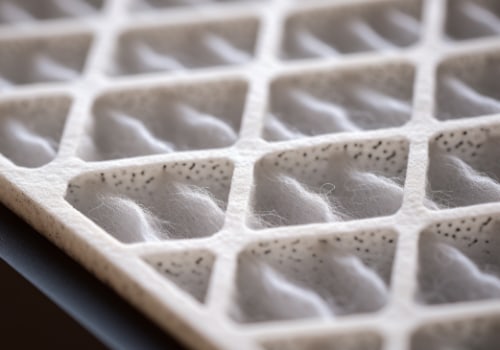
A 4-inch filter like the 12x26.5x4 already has an efficiency advantage — its greater depth holds more filtration media, giving higher MERV ratings more room to perform without sacrificing airflow as quickly as thinner filters.
What the MERV Scale Actually Tells You
MERV stands for Minimum Efficiency Reporting Value. It's a standardized rating developed by ASHRAE that measures how effectively an air filter captures airborne particles between 0.3 and 10 microns. The higher the number, the smaller the particles a filter can trap — and the more resistance it adds to your system's airflow.
For 12x26.5x4 air filters, MERV ratings typically range from 8 to 13. Each step up the scale captures a meaningfully different category of pollutant.
Here's what each level captures:
MERV 8 — Dust, pollen, dust mite debris, mold spores, pet dander
MERV 11 — Everything above, plus fine dust, smoke particles, finer pet allergens, and some bacteria carriers
MERV 13 — Everything above, plus fine combustion particles, virus-carrying droplets, and ultrafine particulate matter (PM2.5)
In our experience, most homeowners underestimate what's floating in their air — and overestimate what a lower-rated filter actually removes.
How to Match MERV Rating to Your Household
Standard Households: MERV 8
If your home has no allergy sufferers, no pets, and no ongoing air quality concerns, a MERV 8 filter does the job efficiently. It balances filtration with airflow, protects your HVAC equipment, and keeps your system running without unnecessary strain. It's the starting point — solid, reliable, and appropriate for many homes.
Pet Owners and Mild Allergy Sufferers: MERV 11
Pet dander is one of the most persistent indoor allergens. A MERV 11 filter captures significantly finer particles than MERV 8, making a noticeable difference in homes with dogs, cats, or anyone who sneezes more than they should. We've consistently seen that upgrading from MERV 8 to MERV 11 is one of the most impactful changes a pet-owning household can make.
Asthma, Severe Allergies, or Health-First Priorities: MERV 13
MERV 13 is where filtration gets serious. It captures fine particulate matter — including smoke particles, smog, and the microscopic carriers that bacteria and viruses often attach to. The EPA recommends MERV 13 or higher for households wanting the strongest layer of air filtration protection from a standard HVAC system. If someone in your home has asthma, chronic respiratory issues, or a compromised immune system, MERV 13 is the clear choice.
One Critical Caveat: Know Your HVAC System
Higher MERV ratings add airflow resistance. Not every HVAC system fan can handle a MERV 13 filter without working harder than it should. Before upgrading, check your system's manual or consult a qualified HVAC technician. A filter your system struggles to pull air through will reduce efficiency and can accelerate equipment wear — the opposite of what you're going for.
"After working with thousands of homeowners and manufacturing millions of filters, we've learned that the right MERV rating isn't about buying the highest number — it's about matching the filter to the home. A well-chosen MERV 11 in the right system will outperform a MERV 13 that's choking your airflow every single time."
Essential Resources on "12x26.5x4 Air Filters"
1. What Is a MERV Rating? — U.S. Environmental Protection Agency
The EPA's official explainer on how MERV ratings work, what particle sizes each tier captures, and how to select the right filter for your HVAC system.
https://www.epa.gov/indoor-air-quality-iaq/what-merv-rating
2. Guide to Air Cleaners in the Home — U.S. Environmental Protection Agency
A comprehensive consumer guide covering furnace filters, portable air cleaners, and how different MERV levels affect indoor air quality and health outcomes.
https://www.epa.gov/indoor-air-quality-iaq/guide-air-cleaners-home
3. ASHRAE Standard 52.2 — American Society of Heating, Refrigerating and Air-Conditioning Engineers
The governing industry standard used to test and assign MERV ratings to air filters. The technical benchmark behind every number on your filter's label.
https://www.ashrae.org/technical-resources/bookstore/standards-52-1-and-52-2
4. Indoor Air Quality — U.S. Environmental Protection Agency
The EPA's central hub for indoor air quality research, guidelines, and pollutant-specific resources for homeowners and building managers.
https://www.epa.gov/indoor-air-quality-iaq
5. Indoor airPLUS Technical Bulletin: Filtration — U.S. Environmental Protection Agency
An EPA technical bulletin specifically focused on residential HVAC filtration standards, including guidance on filter selection, slot design, and MERV minimums for healthy home construction.
https://www.epa.gov/sites/default/files/2020-06/documents/2019.11_tech_bulletin_filtration.pdf
6. NIOSH Indoor Environmental Quality — Centers for Disease Control and Prevention
CDC guidance on workplace and residential indoor environmental quality, including how airborne particulates affect respiratory health and the role of filtration. https://www.cdc.gov/niosh/topics/indoorenv/default.html
7. ASHRAE Position Document on Filtration and Air Cleaning — ASHRAE
ASHRAE's official position on the role of filtration and air cleaning in maintaining acceptable indoor air quality across residential and commercial environments. https://www.ashrae.org/file%20library/about/position%20documents/filtration-and-air-cleaning-pd.pdf
Supporting Statistics
1. People spend approximately 90% of their time indoors, making indoor air quality a persistent daily health factor — not a seasonal concern. Poor filtration means that exposure compounds over time, especially in tightly sealed homes.
Source: U.S. Environmental Protection Agency
2. MERV 13 filters are required to demonstrate at least 50% removal efficiency for the smallest particles tested under EPA and ASHRAE standards. For health-sensitive households, this isn't a marginal improvement over MERV 8 — it's a fundamentally different category of protection.
3. MERV 7–13 filters are considered nearly as effective as true HEPA filters for practical residential applications, according to EPA guidance. This means upgrading from a basic filter to a MERV 11 or 13 puts you in serious filtration territory without requiring costly HEPA system modifications.
Source: Guide to Air Cleaners in the Home
Final Thought & Opinion
The conversation around MERV ratings tends to default to "higher is always better." In our experience, that framing misses something important.
The best MERV rating for your 12x26.5x4 air filter is the one that matches your specific household, your air quality needs, and your HVAC system's realistic capacity — in that order.
For most homeowners, MERV 11 hits the practical sweet spot: meaningfully better filtration than a standard MERV 8, without pushing airflow resistance into territory that stresses your equipment. For households managing health conditions or serious allergen exposure, MERV 13 is absolutely worth the upgrade — provided your system supports it.
What often gets overlooked is the advantage that a 4-inch filter already gives you. The added depth means more filter media, which allows higher MERV ratings to perform at their best. A 12x26.5x4 MERV 13 is typically easier on your system than a 1-inch MERV 13 of the same face size — and it lasts longer, too.
The bottom line: don't default to MERV 8 out of habit, and don't jump to MERV 13 without checking your system. Make the intentional choice.
FAQ on "12x26.5x4 Air Filters"
Q1: What MERV rating is best for a home with pets?
A: MERV 11 is the most practical choice.
Captures fine pet dander and hair particles more effectively than MERV 8
Compatible with most standard HVAC systems
Noticeable improvement for mild to moderate allergy sufferers
Q2: Can I use a MERV 13 filter in any HVAC system?
A: Not necessarily.
MERV 13 adds more airflow resistance than MERV 8 or 11
Check your HVAC manual for maximum allowable filter resistance (static pressure)
When in doubt, consult a licensed HVAC technician before upgrading
A 4-inch filter, like the 12x26.5x4 handles higher MERV ratings better than thinner 1-inch filters
Q3: How often should I replace a 12x26.5x4 air filter?
A: Every 60–90 days under normal conditions.
Replace every 30–45 days if you have pets, allergy sufferers, or live in a high-pollen area
Check filters monthly — visible gray loading means it's time for a change
A clogged filter restricts airflow regardless of its MERV rating
Q4: Is a MERV 8 filter good enough for most homes?
A: Yes, for homes without specific air quality concerns.
Captures dust, pollen, mold spores, and larger airborne particles
Lowest airflow restriction of the three common residential tiers
Adequate for HVAC equipment protection and general household use
Upgrade to MERV 11 if anyone in the home has allergies or asthma
Q5: Does a higher MERV rating mean my HVAC system will work harder?
A: It can — but the 4-inch depth of the 12x26.5x4 size helps offset that.
Thicker filters hold more media surface area, reducing resistance compared to 1-inch filters at the same MERV
MERV 13 in a 4-inch filter is generally manageable for most modern systems
Monitor your system's airflow and energy consumption after any upgrade
A balanced filter — right MERV for your system — protects both air quality and equipment efficiency
Ready to Breathe Easier?
Browse our full selection of 12x26.5x4 air filters in MERV 8, 11, and 13 to find the right fit for your home and HVAC system. The right filter, installed correctly and replaced on schedule, is one of the simplest ways to protect the air your family breathes every day.
Learn more about HVAC Care from one of our HVAC solutions branches…
Filterbuy HVAC Solutions - Air Conditioning Service
2521 NE 4th Ave, Pompano Beach, FL 33064
(754) 247-3511
https://maps.app.goo.gl/JmWkEXya7uzuLzBh8